We originally installed solar panels on our roof in December of 2009 (activated and producing energy by the end of January 2010). We did it partially because it was the right thing to do (climate change, air pollution, safety of energy workers, environmental justice), but also because it was going to be a great financial move for us. Given the incentives at the time (more on that in a bit), the solar company estimated we would “break even” in about three years (I was guessing a slightly more conservative four years or so). It was a 28 panel, 5.04kW installation generating an estimated 6,450 kWh each year, which worked out to about how much electricity we were expecting to use (some years we used slightly more than we generated, some years we used slightly less). It did pay for itself in about four years, which means that since sometime in late 2013 or early 2014 it’s been pure “profit” for us (and tax-free profit at that).
But since that time there have been some changes in our electricity usage.
- We finished our basement.
- We replaced our gas stove with an electric one.
- We bought two electric vehicles (which we charge at home).
- We both retired (so spend a lot more time at home, using a lot more electricity)
- My Mom moved in with us (into that finished basement, therefore using a lot more electricity).
As a result, while our system is still producing the same amount of energy (there has been no drop off in production), we are using almost twice as much electricity. So we wondered if it might make sense to add some additional panels to our roof. We weren’t sure if this would make sense, because the original system (naturally) put the panels in the spots that received the most sun (generally south and west facing roof space).
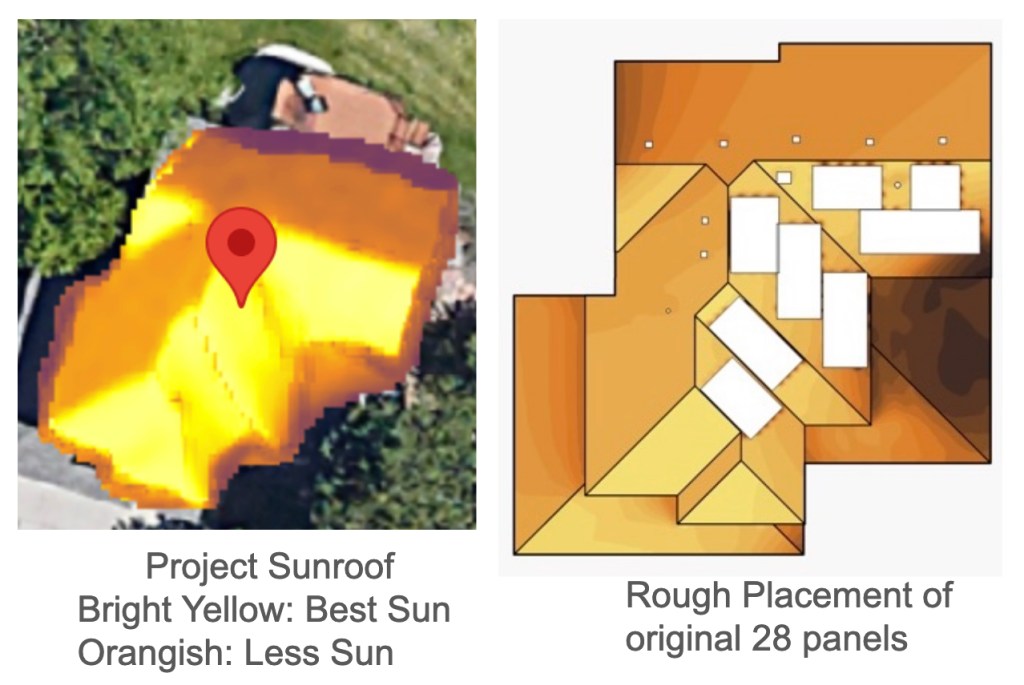
Which means the new, additional panels would have to be placed in less optimal positions on the roof, that receive less sun and are at a less advantageous angle. But we figured it was worth finding out (and, honestly, because we feel strongly about this issue, we were very willing to do this even if financially it wasn’t a fantastic deal). As it turns out, it’s still a pretty good deal, so today we installed 13 additional panels as well as two Powerwall batteries.
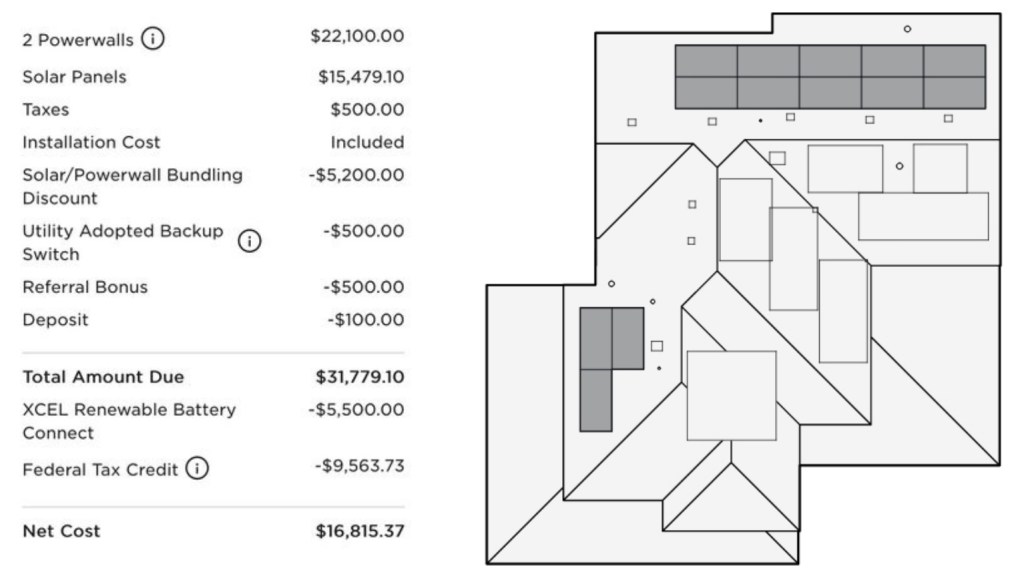
It’s helpful to look at the solar panels and the batteries separately, as the solar panels are pretty much unequivocally a good deal and the batteries may or may not be (and not everyone will want the batteries). And the details really show how much solar has improved in the last 14 years since our original installation.
The Solar Panels
As you can see, we are installing 13 additional solar panels (the dark grey images in the right-hand image above). These panels are individually just slightly bigger than the original panels, but pretty close to the same size. But these new panels will actually produce much more power per panel than the original 28. It is a 5.265kW system (so about 4.4% more capacity with less than half the number of panels) and is expected to produce about 5,160 kWh/year (less than the original system because of receiving fewer photons). Which means each panel (on average) will be producing 397 kWh/year, compared to our original panels which (on average) are producing 230 kWh/year. (Again, an important reminder, the originals also get much more sun than the new ones, so the efficiency improvements are even better than what those numbers indicate. If they were being installed in the location of the original system, they would be generating more power than the original with less than half the panels ~520 kWh/year is my estimate if they were in the original position.)
The cost per panel (before incentives, inclusive of everything including inverters and installation) of the original 28 was $1,368 (inflation adjusted: $1,954). The cost per panel (before incentives, inclusive of everything) of the new ones is $1,132. While the original ones “broke even” after about 4 years, these new ones will likely break even after 6-8 years. The reason for the longer payback is the difference in incentives.
Solar Panel Incentives, Then and Now
When we purchased our original system in 2009 the incentives were better. There was a federal tax credit of 30% and, at the time, there was also a combined state and utility rebate of around 40%. So our net cost was just over $2,500 when all was said and done, which was why I was flabbergasted that I couldn’t convince others to install them.
There are still incentives now, but they aren’t as good. There is still a 30% federal tax incentive, and we also received $500 by using a Tesla referral code. But, alas, there is no longer a state or utility incentive (Colorado and Xcel Energy, respectively). So when you combine the incredible improvements in cost and efficiency in solar panels in the last 14 years with the less advantageous placement for sun exposure and the lower overall incentives, the payback period is a bit longer (but 6-8 years still isn’t bad).
So, for our solar panels (separated out from the batteries), this is what our costs look like.

The Batteries
You don’t have to get batteries. If we were just getting the solar panels, this is definitely a good financial decision for us (in addition to being the right thing to do). The batteries, however, might be a different story. At the time of our initial installation in 2009, home battery storage really wasn’t a thing. But these days it is and there are two main reasons to consider getting them.
- Arbitrage Opportunities
- Eliminating Power Outages
Arbitrage Opportunities
In many places (including Colorado), utilities have implemented time-of-use electricity rates, charging more when demand is high and less when demand is low. (This makes sense from a market perspective, of course, but it also makes sense from a grid utilization perspective.) For us, that means electricity is currently most expensive between 3 and 7 pm, slightly less expensive from 1 to 3 pm, and least expensive between 7 pm and 1 pm the next day. This works really well for us, because solar panels generate the most energy in the afternoon, we schedule our EVs to charge overnight, and we can run our dishwasher and do our laundry during the least expensive times. Interestingly, our utility is likely to going to change those peak hours in the next year or so to 6 to 9 pm because of the increase in solar production – both rooftop and utility – on the grid. And, with our new system, it may make more sense for us to “charge when the sun shines.”
Having batteries allows you to charge them up when you are generating excess solar energy and then discharging them when you aren’t. This sets up an arbitrage opportunity, when you can “sell” energy back to the grid (and/or use stored energy) when it’s expensive, and then pull from the grid when it’s less expensive. In places like Texas, this has led to what’s often referred to as “virtual power plants“, where in real-time you can decide whether to sell your stored energy to the grid on current market rates. In Colorado, our utility (Xcel Energy) is currently taking a different approach, paying us a set amount that allows them to access our battery storage as needed for the next five years. (That’s the $5,500 Xcel Renewable Battery Connect in the screenshot above.) Effectively, this lets you lower the total overall cost of any electricity you do use from the grid, and maximize the credit you get for selling any excess back to the grid.
Eliminating Power Outages
While not strictly a financial benefit, the batteries also allow our house to continue using electricity even when the grid goes down. Thankfully, our power doesn’t (currently, no pun intended) go out very often. But when it does, we’ll now continue to be able to operate as usual. Our system will automatically and immediately switch over to the batteries so we will barely notice (other than the app notifying us). Given that we have two batteries and solar, we theoretically could run for a very, very long time (almost indefinitely) without the grid.
Tesla just released the Powerwall 3 and, if we were designing the system today, they would probably design it with one Powerwall 3 instead of two Powerwall 2’s. That’s because the Powerwall 3 has a much higher peak power output (~30 kW). The only reason we really needed two of the Powerwall 2’s (each with about 7 kW max output) was to be able to run everything when the grid was down. (I suspect, but don’t know, that if we got one Powerwall 3 instead of the two Powerwall 2’s, the break even time on the battery would be about half.)
Here’s what the batteries cost (separated out from the panels):

It’s really difficult (now) to calculate when we might “break even” on this. We will certainly “make” some money from the arbitrage, but it’s hard to tell how much. And certainly having power when the grid is down has value, but that’s hard to quantify as well. But the other piece is that incentive from our utility is for just the first five years. I fully anticipate that when those five years are up there will either be another five year contract (with a fairly significant incentive), or Colorado will operate like Texas currently does and we’d get paid on demand. If either of those happen, the Powerwalls could easily pay for themselves in 8-10 years as well (maybe fewer), and then produce profit after that. If not, they might not ever pay for themselves.
Total Cost
So our total up-front cost will be $31,879. But after the incentive for the batteries from Xcel (which we should get within a couple of months), and the Federal Tax Incentive (which we will get in early 2025, although we’ll adjust our withholding now so we’ll start getting it back monthly), our net cost for the secondary solar panel system plus the two batteries will be $16,916 (the solar panels by themselves just over $10,000; not everyone will want or need the batteries).
Some folks will look at that number and think it’s a lot, others will look at it and think it’s not that much (especially because it includes the battery backup). But since these should last for at least 25 years (and most solar panels are producing longer than that), they will likely earn bond-like returns over that period of time (and possibly equity-like returns if they do continue to produce for longer than 25 years). They also serve as an inflation-hedge (no matter how much the cost of electricity goes up due to inflation or other reasons, your electricity is already paid for.)
So if you own your own house I would highly encourage you to get bids to see how much solar (and possibly batteries) would cost and how amenable your roof orientation is for sun exposure. If Tesla operates in your area, use this referral code when you request your bid online. If you eventually go with them, you’ll get $500 off (you have to use the referral code from the get-go to get that discount). But don’t get a bid just from Tesla, get bids from 2-3 different solar installers as prices can vary based on local conditions and installers (although Tesla is usually very competitive).
For many people, this will be a great financial decision. And even if it’s somewhat of a toss-up financially, I’d urge you to also consider the broader benefits for society (climate change, air pollution, safety of energy workers, environmental justice). Even if we didn’t think this would eventually pay off financially, we kind of think about this as part of our charitable giving. It just happens to be charitable giving that has the potential to more than pay for itself.
 Fisch Financial
2 thoughts on “Our New Secondary Solar Panel System (and Battery Backup)”