I was a guest on the Teach and Retire Rich Podcast talking about electric vehicles this week. I do want to reemphasize a point that was made several times on the podcast, which is that for many folks their first EV should likely be an “around town” commuter car, which means it doesn’t have to be a new EV with a ton of range. I generally recommend buying used vehicles, or perhaps buying new and driving for a really long time (this is what we’ve typically done). Financially buying a used EV right now for your daily driver makes a ton of sense, even if you aren’t ready to commit to an EV for those occasional road trips. But even for road trips, if you buy almost any new EV with an NACS port, road trips are really, truly not an issue. (Check out Tesla’s Supercharger Network as well as PlugShare to get an idea of the existing charging infrastructure, and of course dozens of charging stations are getting added daily in the U.S.)
Dan mentioned that I had shared a document with him with some info about EVs, so I thought I would include that information below.
Cost of Car: People tend to think of it as monthly cost (car payment plus), but really should think about it as cost per mile driven.
- Fuel
- Gas is currently ~$4/gallon average nationwide. (While I don’t wish higher prices on anyone, even at current prices gas is way underpriced considering its externalities.)
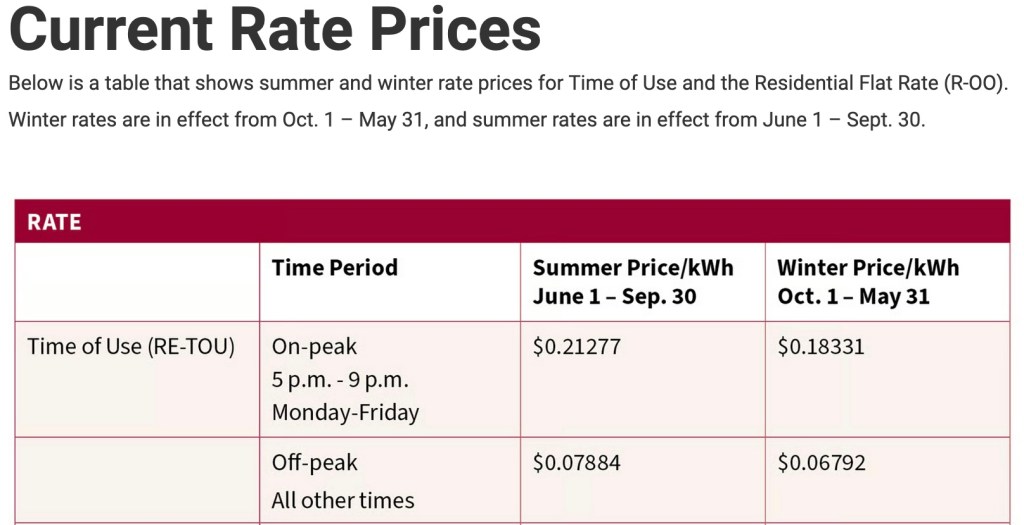
- We have time of use pricing for electricity. We always charge our car during off-peak pricing (between 9 pm and 5 pm), so we always get the lowest charging rates. In the podcast I mentioned $0.068 per kWh, which is the “winter” price (October – May). It’s a bit more in the summer (June – September), $0.07884. So the average yearly rate is actually $0.07156*, so I’ll use that number below.
Our Tesla Model Y has a75 kWh battery, which is rated at 320 miles of range (it typically gets less, but that’s also true for mpg ratings for ICE vehicles)
75 * $0.07156 = $5.37 to “fill up”
$5.37/320 = $.0168/mile
If you compare that to a hybrid ICE vehicle that is rated for 50 mpg: $4.00/50 = $.08 per mile, the ICE vehicle costs 4.8 times as much for fuel. So if you calculate my EV equivalent cost for gas, it would be $0.83/gallon with current prices.
If you compare it to the average vehicle in the US that gets ~27 mpg: $4.00/27 = $0.148/mile, that’s 8.8 times as much, so equivalent to $0.45/gallon
If you compare to many bigger vehicles at ~20 mpg: $4.00/20 = $0.20/mile; 11.9 times as much, so equivalent to $0.34/gallon.
- Maintenance
- No oil changes. No transmission or muffler repair. No spark plugs. Replace brake pads way less often. Less than 30 moving parts.
- In general, regular maintenance on an EV is tires, windshield wiper fluid, wiper blades, and cabin air filter. Roughly 40%-50% less on maintenance.
- Maintenance: $0.061/mile for gas, $0.031/mile for EV, roughly double
- Also, don’t minimize the huge time and hassle savings from not taking your car into the mechanic nearly as often (oil changes, repairs, etc.).
- Convenience
- No going to the gas station.
- Far fewer trips to mechanic (and often they can come to you with mobile service).
- Start every day with a full tank. The only time we need public charging is on road trips (and, as I mentioned, we can often charge overnight for free with a Level 2 charger at a hotel or a standard 110 outlet at an Airbnb).
- “Full Self-Driving”: As I said, it’s not really “full self-driving” yet, but it is amazingly good, and as a driver-assist technology can relieve a lot of the stress of driving.
- Safety
- EVs are structurally safer because of the low-center of gravity due to the skateboard battery pack (as well as providing impact resistance in collisions).
- EVs have a much better crumple zone in the front (instead of an engine block coming into your front seats).
- EVs also have the ability to accelerate out of trouble.
- Charging
- All new EVs in the U.S. now come with the North American Charging Standard port (NACS). Which means that charging stations are beginning to transition to NACS ports and they all have access to the Tesla Supercharging Network. Road trips are really not a problem (again, Plugshare, Tesla Supercharger Network)
- The average daily commute in U.S. is about 30 miles round trip. If your household owns more than one vehicle, only one has to be road trip capable (or you can rent exactly what you need for the occasional road trip and still come out ahead). So buying a used EV can make a ton of economic sense. For example, you can get used previous generation Nissan Leafs (~2013-2016) for under $6k that would work just fine for most daily commutes as long as you have charging at home. And newer generation Leafs (and others) under $15k with even more range. And with the Inflation Reduction Act being passed 3 years ago, we will see a big surge in the used EV market starting now and over the next 2-3 years.
- Here are three of the road trips we’ve done (starting from and returning to the Denver Metro area):
- The canyons (Arches, Bryce, Zion, Grand) (over 1,500 miles)
- Tetons/Yellowstone/Glacier/Banff/Jasper (over 3,200 miles)
- West Coast (Arches, Great Basin, Yosemite, Redwoods, Olympic, Mt. Rainier (over 4,000 miles)
…. Zero charging issues or concerns.
- You do need to retrain your brain. On road trips, we are used to “filling up the tank” when we stop at a gas station. With an EV, you typically don’t – you just get enough charge to get to your next charging stop (and your car tells you how much you need to charge to). This is because EVs charge faster when the battery is at a lower state of charge. That doesn’t mean you can’t charge up to 100% if you need it, it just means you usually don’t because the time it takes to charge to 80% is much less than the time for that that last 10-20%. A lot of the “stop time” comparisons you see include the extra time to charge to 100% which is rarely necessary (although easy enough to do if it’s a meal stop).
6. Other
- Climate change, pollution, safety for workers, and other externalities.
- Most EVs available in the U.S. have a much higher percentage of “made in America”, which has knock-on positive environmental effects in addition to the local economic impacts.
- Battery degradation is pretty minimal (and only really impacts road trips). Batteries will likely outlast the car, and even then can be used for energy storage or recycled (more than 95% recyclable now, increasing toward 100%). And batteries are improving not only on cost but on charging speed, with solid-state batteries coming that will decrease costs, decrease charging time, increase range, and increase safety. Even the minimal inconvenience of having slightly longer stops on road trips will be eliminated.
- Chinese EVs are coming that have not only achieved price parity, but are already cheaper than “equivalent” ICE vehicles. And all car companies are coming out with newer and better EVs.
- They are just better cars to drive. Quieter, better acceleration, better torque, better handling.
- As I said, it’s reasonably likely the 2023 Model Y will be the last vehicle we’ll ever buy because it will meet our needs and last for 25-30 years. It’s possible that there will be enough advances in safety, range, etc. that we get one more, but that would only be because we really wanted to, not needed to.
*Because we have both solar panels and battery backup, our costs are actually lower than this. We basically never pay anything other than off-peak prices because our solar+battery means we never pull from the grid during peak hours (5 pm – 9 pm). In the podcast I said that more than 50% of our electricity came from our solar, but that has actually changed a bit since we’ve gone to an all-electric house. With the addition of the heat pump and heat pump water heater, our solar is now providing about 34% of our entire electricity needs. Which means that for us, you can take another 1/3 off the costs shared above because 1/3 of our electricity is free. Which means our cost is really about $3.54 to “fill up” or $0.0111/mile. You can lower all of the other price comparisons by 1/3 in a similar fashion, which only increases the advantage over an ICE vehicle.
 Fisch Financial