This post comes with the usual caveat: I am not a tax expert and this is for informational purposes.
One of the great things about the tremendous decrease in the cost and difficulty of investing (thank you Jack Bogle) has been that many more people are investing in stocks and bonds through brokerages like Vanguard and Fidelity. In addition, many folks have discovered that instead of leaving their savings in a low-interest savings account they can move them to either a high-yield savings account or a money market account at their brokerage. While this has provided a nice boost to the interest they earn, it has come with a small downside that their taxes get a bit more complicated due to having another form or two they have to deal with (typically a 1099-INT and/or 1099-DIV). Since most people use software to do their taxes, that’s really a fairly minor inconvenience.
But there is something that I’ve found that many people are unaware of and that sometimes the software doesn’t point out to them, which is that interest earned from U.S. Treasuries (including T-Bills) are free from state and local taxes. How much this matters to you, of course, depends on which state you live in. Some states don’t have state income taxes, so it’s not applicable to you. And if you live in California, New York, or Connecticut, you have special rules. But in all other states (and even in those three with some exceptions), you can deduct any interest earned from Treasuries from your income you claim for your state (and local) income tax. Depending on your state income tax rate, and how much you earn from Treasuries, that can be a decent amount of savings.
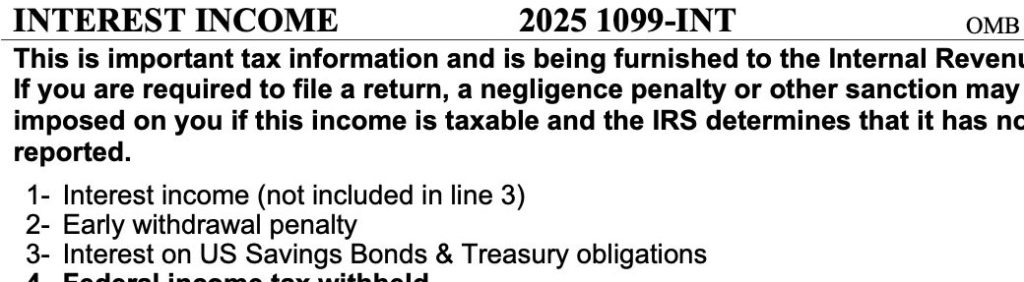
There are two main places to look for the amounts you can deduct. The first is relatively easy. If you invest directly in T-Bills (or savings bonds) then you can deduct the total amount of interest you earn from your state taxes. You can often find this on line 3 of your 1099-INT.
But the second place isn’t nearly as obvious. Most mutual funds and ETFs often have at least a little bit (and sometimes a lot) invested in treasury obligations, and you have to do a bit more work to figure this out. All brokerages publish a document that helps with this (Vanguard for 2025 pdf, Fidelity 2025 pdf), listing the percent of dividends for any given fund that is from government securities and therefore exempt from state (and local) income taxes. These percentages are often very small. For example, for VTSAX, it’s 0.44%. So if you earned $1,000 in dividends from VTSAX, you could deduct $4.40 from your state taxes (1000 * 0.44%). But for some funds, notably including money market funds, the percentages are much higher. For example, for VMFXX (Vanguard’s default money market fund), it was 66.61% in 2025 (meaning that if you had $1,000 in dividends, you could deduct $666.10 from your state taxes). For Fidelity’s default money market fund SPAXX, it was 50.90% in 2025. And there are some funds that invest completely (or mostly) in treasuries. For example, VBIL is a 0-3 month Treasury Bill ETF, and you can deduct 100% of that interest from your state taxes.
Depending on how much you have invested, which funds you are invested in, and what your state marginal tax rate is, this can be a decent amount of savings. As an example, Colorado currently has a flat tax rate of 4.4%. So if you have a total of $5,000 in interest that is deductible, which is not an unreasonable amount for many folks who are invested in T-Bills or 100% treasury funds, money market funds (large percentage deductible), and other equity and bond funds (small incremental additions), that would result in $220 in state tax savings. If you happen to live in a different state with higher marginal tax rates, the savings can be even more.
And many older folks have much more invested in T-Bills so their state tax savings can be significant.
So if you haven’t filed your state taxes yet for 2025, take a look and see if you might have some additional deductions you can take. If you’ve already filed, then make a note to check on this next year (or, if it would be a significant deduction for 2025, perhaps file an amended state tax return).
 Fisch Financial