I’ve been doing some financial presentations for educators in various Colorado school districts. As part of the intro to my presentation I reference the fairly typical “90-minute New Employee Orientation” that school districts often provide for new teachers and that, while these are well-intentioned, they usually fall woefully short of what they could (and should) accomplish. Often they are a brief introduction of the district leadership, a general overview of the benefits offered by the district, and then a generous side-helping of filling out various required forms. Then the new teachers are told “Good Luck!” and sent off to an endless series of other meetings, and then all-too-soon the first day of school arrives and the whirlwind continues.
Here’s an excerpt from a local school district’s benefits booklet.
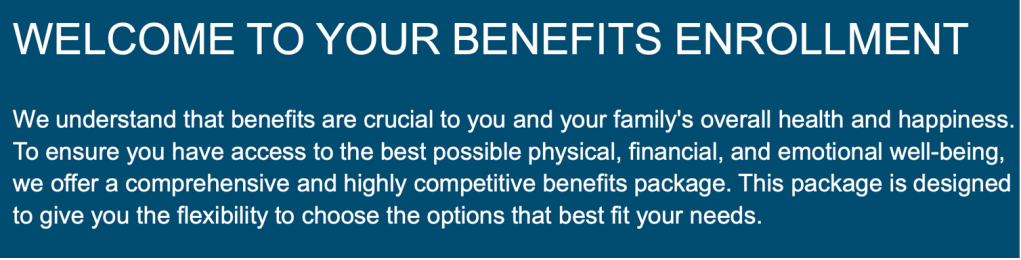
This sentiment is great, and clearly the district understands the importance of these topics. But the disconnect is between this sentiment and the reality of the orientations we are providing. I think we can do better, and we must do better. And this is not just because it will be very helpful personally to these new teachers, but it’s in the school district’s self-interest. The more financially literate new teachers are, the more stable their finances are, the less stress they will be under. This can’t help but make them better educators and, over time, help tremendously with teacher retention. These are mission-critical goals for school districts and I think many (most?) of them are missing out on a huge opportunity.
Now, I want to be clear. I completely understand that there is already way too much information communicated to new teachers in way too brief a period of time. By adding a more in-depth financial orientation to the mix, we are indeed adding to this potential overload. The best answer to this, of course, is to provide more time. Some forward-looking school districts have figured out that they should start providing training for (and paying) new teachers several months before they actually start in the classroom (so typically start their orientation – and pay – in June even though the school year might not begin until August or early September). While I highly recommend school districts do this, I know that not many will take me up on this recommendation.
But even if districts choose not to offer this extended orientation, I think they can (and must) find ways to include this financial orientation for new teachers. This could be something like adding half a day to their contract to provide this time (not nearly as expensive as starting them in June), or it could be providing this financial orientation over the course of their first year (or two or three, depending on how in-depth you want to go). This could fit in nicely with the mentorship programs most schools already offer for new teachers, and would allow for additional focus on overall financial literacy, not just employer-related topics. (One downside of this approach, however, is that they will end up making benefits and other decisions before getting the full orientation, which could not only lead to missed opportunities but, behaviorally, it’s much more difficult to make changes after the fact then to make the correct decision right off the bat.) And, of course, the best of both worlds would be doing both an initial financial orientation followed by on-going financial literacy education through their mentorship years.
So let me lay out some initial ideas of what that up-front orientation might look like, based on the presentations I’ve been doing for teachers around the state. (Note: These presentations have not been directed just to new teachers, but to teachers in all stages of their career, but it turns out that the topics are pretty much the same.) This outline focuses primarily on employer-related topics, and some of the linked blog posts (just as ideas) are specific to Colorado and our pension plan. They would be easily adapted to other states and their pension plans. Obviously each school district (and pension plan) has unique topics that might be added to (or subtracted from) this outline, but I thought this might be helpful so people weren’t starting with a blank slate.
An overarching theme of this financial orientation is that we need to provide new teachers with more than “just” an overview of their benefits; we need to look at all employment-related financial decisions new teachers make (and will be making throughout their career). (Ideally, this would then be followed-up with on-going financial literacy on many topics that are not specifically employer-related.) Obviously there are additional topics you might include, and you might choose to go in a different order, but this will at least get us started.
Note: The Salary Schedule piece of this orientation is the only piece that could actually cost the school district any money (by encouraging teachers to move over more quickly on the salary schedule). But presumably districts value this additional education and think it improves the quality of teaching, and all the rest of the items in this orientation either save the district money or have no budgetary impact. And even the “negative” salary schedule impact is arguably made up for in increased teacher satisfaction (and therefore performance) and retention.
- Pension: This is arguably the biggest benefit the school district offers, yet is typically only briefly mentioned in benefits booklets and orientation meetings. Retirement is likely (and hopefully) the biggest expense any of us will ever have, so we should begin with the end in mind. In Colorado, this is Colorado PERA, and most new hires (and, frankly, most veteran teachers) have very little knowledge of the benefits PERA offers.
- Reading, Understanding and Interpreting PERA’s HAS Tables
- Impact of Section 125 Plans (PERA membership before 7/1/2019)
- Purchasing Service Credit: One and Two
- Optimizing Your PERA Benefit (see salary schedule section below)
- Retirement Options
- Other PERA Benefits: Survivor Benefits, Short and Long-Term Disability, Optional Life Insurance, PERAPlus 401k and 457b (see investment section below), Health Insurance Options in Retirement
- Salary Schedule: Most school districts (in Colorado, at least) have a salary schedule, which teachers advance on vertically (with years of experience) and horizontally (with additional education). Almost every new teacher has heard from more veteran teachers, “Be sure to advance horizontally on the salary schedule as quickly as possible!” But there’s a difference between hearing that and actually seeing the numbers.
- Salary Schedule Lanes: How Much of a Difference Do They Make?
- And it’s not just how much more money you will make over time, it’s also the eventual effect on your pension benefit (spreadsheet example from a recent presentation)
- Benefits: This has been the traditional focus of the new teacher orientation although, again, it’s often covered in a superficial fashion and much of the time is spent completing paperwork (electronic or otherwise). I think this can be improved greatly by also focusing on the long-term financial impacts of these decisions, not simply the short-term ones of “which health insurance company do I want?”
- Section 125 Plans: Focus on the savings/impact to take home pay of pre-tax insurance premiums as well as pre-tax FSA and Dependent Care FSA contributions (spreadsheet from recent presentation – note both tabs); especially for those with PERA membership prior to 7/1/2019.
- Health Insurance: HDHP with HSA vs. Other Choices (spreadsheet from recent presentation – note both tabs).
- Additional Employer-Paid Benefits: Sometimes life insurance, disability.
- Optional Supplemental Benefits: Usually not your best option, but can be valuable if you are not insurable on your own.
- Supplemental Retirement Accounts: Even with a good pension, most people will want to save and invest additional money for retirement in tax-advantaged accounts like IRAs, 401ks, 403bs, 457bs, and HSAs.
- 401ks, 403bs, and 457bs, Oh My!
- Is My 403b Vendor Any Good?
- Fees Matter (and spreadsheet from recent presentation comparing PERA’s 401k with Equitable’s standard 403b offering).
- Using your HSA as a Stealth Retirement Account
- Investing: This would only be covered briefly in a new teacher orientation (it could be covered more in-depth with on-going financial literacy training throughout their mentorship years). But it’s important for teachers to at least be exposed to the idea right off the bat that, with a defined benefit pension, they may want to invest differently throughout their career.
- Are Target Date Funds the Best Choice for Educators? (and spreadsheet)
- Revisit Fees Matter and spreadsheet from above.
- Tax considerations (including Roth vs. pre-tax in terms of both eventual taxable pension benefit but also the effect on student loan payments below)
- Index Funds
- Student Loans: Many new teachers will be arriving with student loans they need to pay off, but not much knowledge about how student loans work. School districts can make a huge impact on the lives of their new teachers by a fairly simple educational session around student loans.
- Colorado Educator Loan Forgiveness
- PSLF and SAVE (including lowering AGI with pre-tax insurance premiums/FSA/Dependent Care FSA/HSA/IRA/401k/403b/457b contributions); spreadsheet from recent presentation
There are additional topics you could include, or you might choose to remove some of the above. In the presentations I’ve been doing (again, not just to new teachers, but to teachers throughout their career) I suggest that we can easily increase teachers’ take home pay by 5%, 10%, 15% or more, and at little or no cost to the school district (again, only the salary schedule portion is a potential cost to the school district). To me, this is incredibly low-hanging fruit that would not only have a tremendous impact on the lives of teachers, but would improve their performance in the classroom and teacher retention (through lowering their stress in their lives due to financial reasons).
I highly encourage school districts to consider enhancing their new hire orientations to include more of a financial piece. I’m happy to brainstorm ideas with you, or if you are in Colorado, I would even be happy to lead such an orientation (similar to the presentations I’ve already been giving, just specific to new teachers).
 Fisch Financial
One thought on “New Teacher (Financial) Orientation”